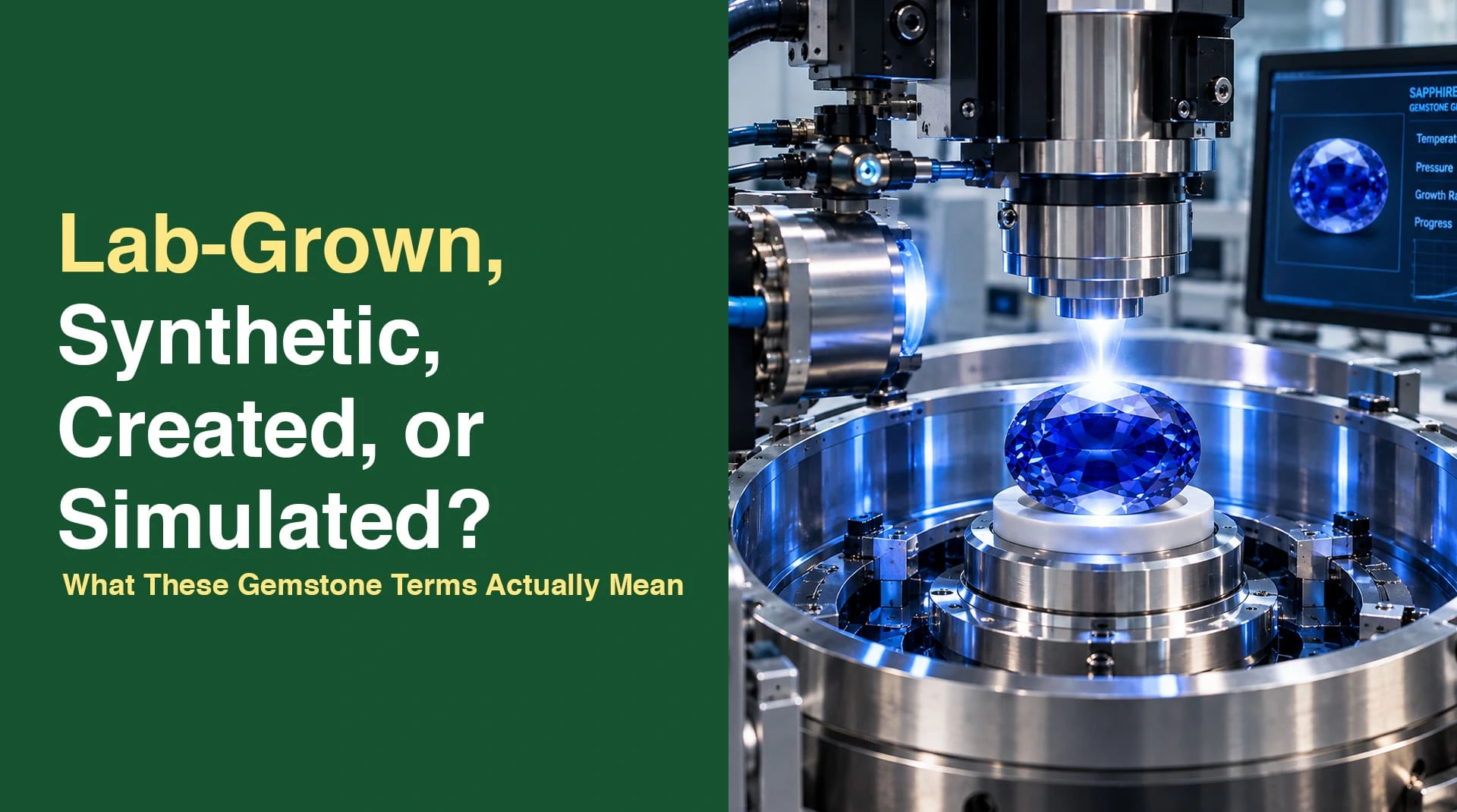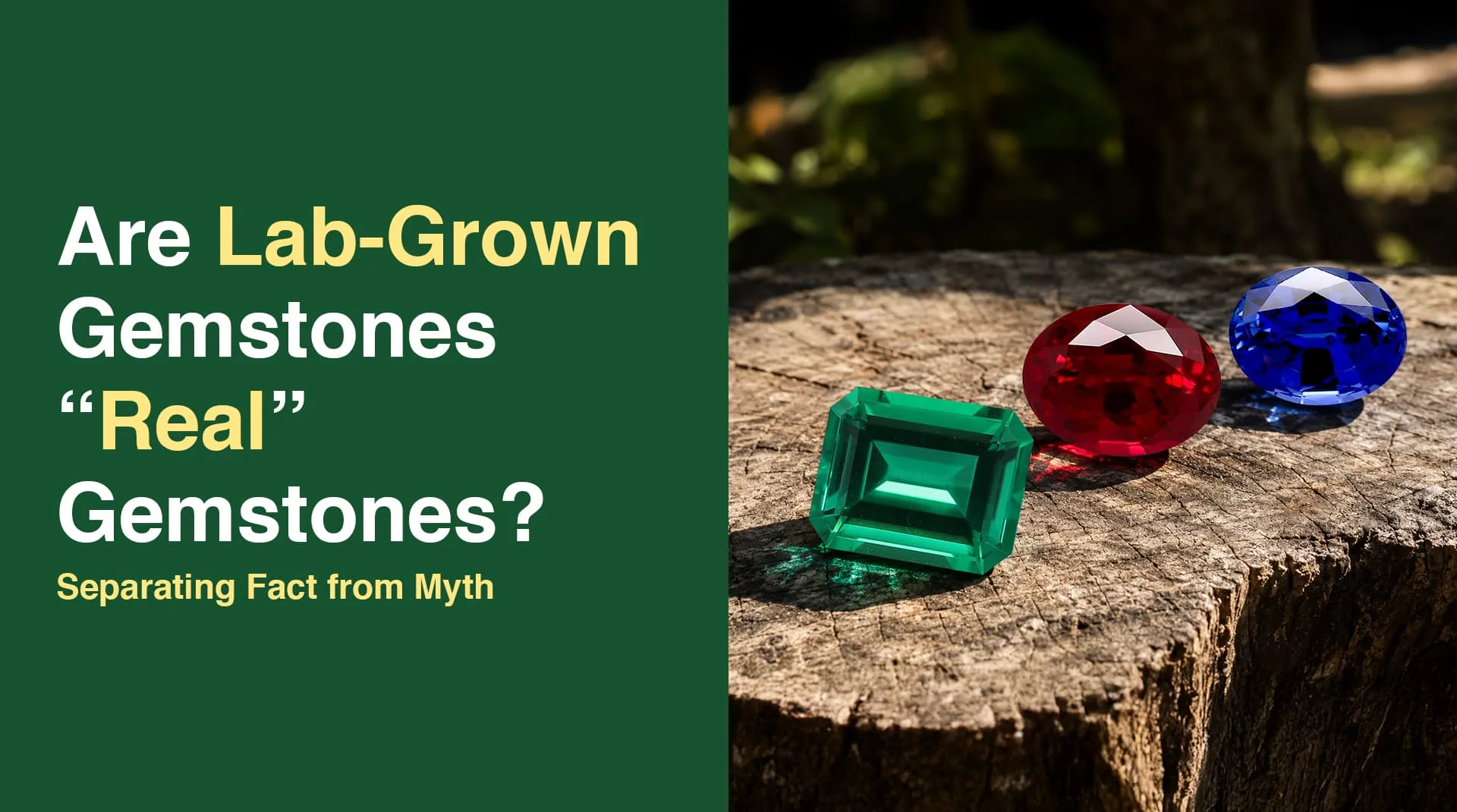
Are Lab-Grown Gemstones “Real” Gemstones? Separating Fact from Myth
When people hear the words lab-grown gemstones or synthetic gemstones, one of the first questions they often ask is: “Are they real?”
The answer depends on what someone means by “real.”
A gemstone made in a lab does not form naturally in the Earth. Still, this does not mean it is fake, plastic, glass, or just something that looks like a gemstone. In gemology, the difference is more specific.
A well-made synthetic gemstone is man-made but has almost the same chemical makeup, crystal structure, and important optical and physical properties as the natural gemstone. The main difference is where it comes from: one forms in nature, the other in a lab.
That’s why terms like Lab grown Gemstones, Synthetic Gemstones, and Lab grown colored gemstones can be confusing. In this guide, we’ll clear up the myths and explain what these terms mean, including the differences between Lab grown Emerald, Ruby, and Sapphire.
The Short Answer: Yes, Lab-Grown Gemstones Can Be Real Gemstones
The term “lab-grown” simply tells you where the gemstone comes from. It means the stone was made in a lab, not formed by nature over time.
It does not mean the gemstone is fake.
In gemology, a synthetic gemstone is man-made but has almost the same chemical makeup, crystal structure, and physical and optical properties as the real gemstone. That’s why “synthetic” does not mean imitation or fake.
For example:
- A lab-grown emerald is created in a laboratory and is made to have the essential characteristics of emerald.
- A lab-grown ruby is created in a laboratory and is made to have the essential characteristics of ruby.
- A lab-grown sapphire is created in a laboratory and is made to have the essential characteristics of sapphire.
In every case, it’s important to clearly say if a gemstone was made in a lab. A lab-grown gemstone should not be sold as a mined one, but being lab-grown does not mean it’s an imitation.
The key question is whether the stone is truly a synthetic version of the gemstone or just something that looks similar.

What Does “Real” Mean When Talking About Gemstones?
Buyers often use the word “real,” but it can mean different things to different people.
Someone may use “real” to mean:
- Formed naturally in the Earth
- Made from the actual gemstone material
- Not made from glass or plastic
- Having the same chemical properties as a particular gemstone
- Being durable enough for jewelry
- Being recognized by gemological professionals
These are not all asking the same thing.
A gemstone can be lab-grown and still be a true synthetic version of a certain gemstone. Meanwhile, another man-made stone might only look like that gemstone but not share its properties.
This is why gemology generally distinguishes between three broad categories:
1. Natural Gemstones
These form naturally through geological processes.
2. Synthetic or Laboratory-Grown Gemstones
These are created by humans in a laboratory but have essentially the same characteristics as the corresponding gemstone material.
3. Imitation or Simulant Gemstones
These are materials that resemble another gemstone but do not have the same essential chemical, physical, and optical characteristics.
For example, a red glass stone may resemble a ruby visually, but it is not a synthetic ruby. It is an imitation.
This difference is key to understanding synthetic gemstones.
Myth 1: “Synthetic” Means Fake
This is a very common misunderstanding.
In everyday language, people often use “synthetic” to mean artificial or fake. In gemology, however, the term has a more specific meaning.
A synthetic gemstone is a man-made material that has essentially the same relevant chemical, crystal, optical, and physical characteristics as its corresponding gemstone. GIA specifically explains that the word “synthetic” does not mean fake in gemology.
The word explains how the stone was made, not that it is just an imitation.
For example:
Synthetic Ruby does not mean “a red stone that looks like ruby.” It refers to a laboratory-created ruby material with essentially the same fundamental characteristics as ruby.
Synthetic Sapphire does not mean “a blue stone that looks like sapphire.” It refers to a laboratory-created sapphire material with essentially the same fundamental characteristics as sapphire.
Synthetic Emerald is a laboratory-created emerald material, not simply green glass.
The word “synthetic” should therefore be understood as a So, “synthetic” should be seen as describing how the gemstone was made, not as another word for fake.astic
This idea is also not true.
Some imitation gemstones may be made from glass or other materials, but that does not mean all laboratory-grown gemstones are made from those materials.
The real difference is in the material.
Imagine two red stones:
- Stone A is a red glass material that has been cut to resemble ruby.
- Stone B is a laboratory-grown synthetic ruby.
Both stones may look red, but they are not made of the same material.
The first is an imitation because it only resembles ruby. The second is a synthetic ruby because it is created to have the fundamental characteristics of ruby.
GIA describes imitation or simulant materials as substances that resemble another gemstone but have different chemical compositions, crystal structures, and optical and physical properties.
This difference is especially important when buying lab-grown colored gemstones.
Is this gemstone laboratory-grown, synthetic, or an imitation?
These terms do not mean the same thing.

Are Lab-Grown Emeralds Real Emeralds?
A Lab grown Emerald is often misunderstood when it comes to lab-grown colored gemstones.
Emerald is a specific gemstone material with recognized chemical and physical characteristics. GIA identifies emerald as a beryl variety with the chemical composition Be₃Al₂Si₆O₁₈.
A laboratory-grown emerald is produced in a controlled setting, not formed naturally over time. Still, a well-made synthetic emerald has the main features of a natural emerald.
Simple comparison:
Lab grown Emerald: A laboratory-created emerald material with essentially the relevant characteristics of emerald.
Green glass imitation: A different material that is cut and colored to resemble emerald.
Just looking at a stone is not enough to tell the difference. Gemologists use special tests and tools to study the material, including its inner features and how it grew.
As with all lab-grown colored gemstones, the origin should be made clear. A lab-grown emerald should be called laboratory-grown, laboratory-created, or synthetic, not sold as a mined emerald. Real Rubies?
A lab-grown ruby is another good example of how a synthetic gemstone is different from an imitation.
Ruby is the red variety of corundum, with the chemical composition Al₂O₃. GIA lists ruby as having a Mohs hardness of 9 and identifies synthetic counterparts as materials that can have essentially the same chemical, physical, and optical properties while being grown in a laboratory.
A Synthetic Ruby is not just a red stone.
It is a lab-grown ruby that has the main features of a natural ruby.
This is different from a red glass imitation, which might look similar but does not have the same chemical makeup, crystal structure, or important physical and optical properties.
One interesting fact about synthetic ruby is that laboratory-grown ruby has been produced for more than a century and has applications beyond jewelry, including scientific and technological uses. GIA notes that synthetic crystal production has a long history and that synthetic ruby was among the earliest successful synthetic crystals produced for faceting-quality material.
So, when someone says:
“A lab-grown ruby is fake because it was made in a laboratory,”
that statement is too simple.
A better explanation is:
A lab-grown ruby is different from a natural ruby because of how it was made, but it is also different from a ruby imitation because it is a real synthetic ruby.

Are Lab-Grown Sapphires Real Sapphires?
A lab-grown sapphire is also made in a controlled lab setting.
Sapphire is a variety of corundum and has a recognized chemical composition of Al₂O₃. GIA describes synthetic sapphire counterparts as materials that can have essentially the same chemical, physical, and optical properties as sapphire while being grown by humans in a laboratory.
This means Synthetic Sapphire is not the same as a blue imitation.
For example:
- A synthetic sapphire is grown as sapphire material.
- A blue glass stone may only imitate the appearance of sapphire.
Both stones may be blue, but they are not made of the same material.Sapphire is also known for its durability, with a Mohs hardness of 9. GIA notes that sapphire's durability has contributed to its use in applications beyond jewelry, including specialized technical uses.
The same idea applies to lab-grown sapphire in jewelry: its lab origin should be clear, but “lab-grown” does not mean “fake.”Lab-Grown vs. Synthetic vs. Imitation: What Is the Difference?
The easiest way to understand these terms is to look at what the material is and its properties.
|
Natural gemstone |
Forms naturally |
Yes |
|
Synthetic gemstone |
Grown or created in a laboratory |
Essentially yes |
|
Imitation gemstone |
Made to resemble another gemstone |
No |
A synthetic gemstone is intended to reproduce the essential characteristics of a particular gemstone.
An imitation gemstone is intended to resemble the appearance of another gemstone without being the same material.
For example:
- Synthetic Ruby = laboratory-grown ruby material
- Red glass imitation = material that resembles ruby
- Synthetic Sapphire = laboratory-grown sapphire material
- Blue glass imitation = material that resembles sapphire
- Synthetic Emerald = laboratory-grown emerald material
- Green glass imitation = material that resembles emerald
The Federal Trade Commission's Jewelry Guides similarly emphasize that terms such as “laboratory-grown” and “synthetic” should be used for products that have essentially the same optical, physical, and chemical properties as the named gemstone, while imitation products should be identified as imitations or simulations.
How Can Gemologists Tell If a Gemstone Is Lab-Grown?
Even though a lab-grown gemstone can have almost the same main properties as a natural one, experts can still tell where it came from.
Growing in a lab or in nature leaves different marks inside the gemstone.
Gemologists may study:
- Internal inclusions
- Growth patterns
- Crystal structures
- Color distribution
- Microscopic features
- Spectroscopic characteristics
- Other properties using specialized laboratory equipment
GIA explains that differences in inclusions and growth patterns can help gemologists distinguish synthetic gemstones from naturally formed counterparts.
That’s why expert identification and lab reports are helpful if you care about where a gemstone comes from.
If you are interested in the certification and identification process, you can also read our guide:
Can Lab-Grown Gemstones Be Certified?
Myth 3: Lab-Grown Gemstones Are Not Durable
The durability of a gemstone depends on its specific material and characteristics.
A laboraA lab-grown gemstone is not automatically fragile just because it was made in a lab. Synthetic gemstones can have essentially the same physical properties as their corresponding gemstone materials; their durability is related to the gemstone type itself.
For example, ruby and sapphire are both corundum and are known for their high hardness. Emerald has different durability considerations and should be cared for appropriately.
That’s why buyers should look at the specific gemstone instead of thinking all lab-grown colored gemstones are equally durable.
The important question is not simply:
“Was it grown in a laboratory?”
Instead, buyers should ask themselves:
“What gemstone material is it, and what are its physical characteristics?”
Myth 4: Lab-Grown Gemstones Cannot Be Identified
This is another common myth.
Gemological laboratories can identify many laboratory-grown gemstones by studying their internal features and growth characteristics.
Even if a synthetic gemstone shares key properties with a natural one, it will not be exactly the same in every tiny detail.How a gemstone grows leaves unique marks that help experts tell if it was made in nature or in a lab.
This is one reason why it’s so important to be clear when selling synthetic colored gemstones.
Buyers should be able to understand:
- What the gemstone is
- Whether it is lab-grown
- Whether it is synthetic or imitation
- Whether it has received treatments
- Whether a report is available
Why Clear Disclosure Matters When Buying Lab-Grown Colored Gemstones
The words used to describe a gemstone should be clear.
A buyer should not have to guess if a gemstone is:
- Laboratory-grown
- Laboratory-created
- Synthetic
- Imitation
- Simulated
- Treated
The Federal Trade Commission advises that gemstone marketing should accurately represent the nature and characteristics of products and that important information should be disclosed clearly to consumers. Its guidance also distinguishes laboratory-created or synthetic gemstones from imitation materials.
This is important because the word “gemstone” alone does not tell a buyer where the material came from.
A good product description should clearly state where the gemstone comes from.
For example:
- Lab-grown Emerald
- Synthetic Ruby
- Lab-grown Sapphire
These descriptions tell the buyer that the gemstone is laboratory-created rather than mined.
Clear wording helps buyers make smart choices and avoids confusion between lab-grown gemstones and imitations.
The Final Verdict: Are Lab-Grown Gemstones “Real”?
The most accurate answer is: Lab-grown gemstones are not natural gemstones, but a properly created synthetic gemstone can have essentially the same fundamental chemical, physical, and optical characteristics as the corresponding gemstone.
The word “lab-grown” describes the gemstone's origin.
The word “synthetic” describes a man-made gemstone material that reproduces the essential characteristics of the gemstone it represents.
The word “imitation” describes a material that only resembles another gemstone.
These are three separate ideas.
So, a lab-grown emerald is not the same as a mined emerald, but it is not just green glass either. A lab-grown ruby is different from a natural ruby, but it is not just an imitation. A lab-grown sapphire comes from a lab, but a good synthetic sapphire is not just any blue stone that looks like sapphire.
If you are interested in lab-grown gemstones, the most important thing is to know exactly what you are buying. Clear words, honest product descriptions, and proper labeling help you tell the difference between Synthetic Gemstones, lab-grown colored gemstones, and imitations.
Whether you are looking at a Lab grown Emerald, Ruby, or Sapphire, the key is to ask more than just whether it was made in a lab. The better question is:
What is the material, how was it created, and does it have the essential characteristics of the gemstone it represents?
Once you understand this difference, it’s clear: “Lab-grown” does not mean “fake.”
Sources